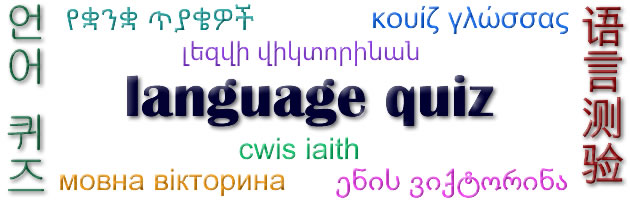
Here’s a recording in a mystery language.
Last week I went to the Polyglot Gathering in Brno in the Czech Republic. This is the sixth Polyglot Gathering I’ve been to, though the first one in Brno and the first one for a few years. The last one I went to was in 2019 in Bratislava in Slovakia.

This year’s Polyglot Gathering took place at Mendel University in Brno (Mendelova univerzita v Brně). There were 827 participants from 67 countries. Apart from English, the most spoken languages were German, Spanish, French, Italian, Russian, Polish and Portuguese, and between us, we the participants speak or are learning 202 languages. Just over half the polyglots were there are under 45, and the rest, like me, are older.

This was the largest language event I’ve been too, and was very well organized. There were talks about language-related topics; introductions to languages; language practice tables; workshops on stand-up comedy, dance, capoeira, juggling, etc; games, quizzes, karaoke, a talent show, a food fair, and tours of local attractions.

Freedom Square (Náměstí Svobody), Brno
I went to a few of the talks, and practised my Mandarin, Cantonese and Japanese at the language practice tables. I also went on a tour of Brno, which was interesting, and to a quiz, a karaoke session, concerts and other activities. The rest of the time I was relaxing, chatting to various people, and teaching people to juggle, or helping them to improve their juggling (see below).

The languages I spoke most, apart from English, were French, Mandarin Chinese, Japanese, Cantonese, German, Welsh, Irish, Spanish and Esperanto. I also spoke (or at least tried to speak) some Czech, Slovak, Russian, Scottish Gaelic, Swedish, Italian, Portuguese and Taiwanese.

The Brno Dragon / Brněnský drak
For anybody interested in languages who wants to meet like-minded people, practice their languages, and have fun, I’d recommend events like this. The next one is the Polyglot Conference in Bologna in Italy in 18-20 November 2026. I haven’t decided if I’m going to go yet.
The other day the word 火箭 (huǒjiàn) came up in my (Mandarin) Chinese lessons. It means rocket or literally “fire arrow”.

I knew that the first characters meant fire, but wasn’t sure about the second character. Once I knew that the word meant rocket, I guessed that the second character meant arrow or something similar. I was right.
One of the things I like about Chinese is that rather than borrowing words other languages, they often coin new words based on native roots, or borrow words from Japanese that are based on Chinese roots.
Other examples featuring the character 火 (huǒ), which means fire, flame, burn, anger or rage, include:
The character 箭 (jiàn) means arrow and appears in words like:
The word 灰心 (huīxīn) came up in my Chinese lessons recenlty. It could be translated literally as ‘ashen heart’ or ‘heart of ash(es)’, but what does it actually mean?

灰心 (huīxīn) means to lose heart, to be discouraged or to despair. 灰 (huī) means ash(es), dust, lime or mortar, and 心 (xīn) means heart, mind, intelligence or soul [source].
灰 can also mean grey/gray when combined with 色 (sè – colour), as in 灰色 (huīsè), so I thought at first that 灰心 meant ‘grey heart’ [source].
Related phrases include 灰心喪氣 (huīxīnsàngqì), which means disheartened, discouraged, downhearted, downcast or in dispair, or literally “ash heart lose qi”, and 心灰 (xīnhuī), which means extremely disappointed or discouraged [source].
The character 心 (xīn) also appears in phrases such as:
The word ワンピース (wanpīsu) came up in my Japanese lessons the other day. You could translate it as ‘one-piece’, and it refers to an article of clothing, but which one?

ワンピース (wanpīsu) [wàńpíꜜìsù] actually refers to a dress or other piece of clothing that comes in one piece, such as a bathing costume / swimsuit, and can be shortened to ワンピ(wanpi). It was borrowed from the English term one-piece, which is an adjective meaning ‘composed of a single integral unit, or so appearing’, e.g. a one-piece metal hammer, or a one-piece article of clothing, especially a swimsuit [source].
ワンピース (wanpīsu) or One Piece is also a manga series, an anime TV series and media franchise. Here’s some music from one of the One Piece spin offs, One Piece film RED, sung by Ado:
A similar word is ツーピース (tsūpīsu) [tsɨːpʲiːsɨ], which means a two-piece suit, particular women’s suits. It comes from English two-piece, which refers to a suit or dress in two pieces [source].
Similar words are also found in Korean: 원피스 (wonpiseu) [wʌ̹npʰi(ː)sʰɯ] = dress, and 투피스 (tupiseu) [ˈtʰu(ː)pʰi(ː)sʰɯ] = two-piece suit / dress [source].
Another word for dress in Japanese is ドレス (doresu), which was borrowed from English dress [source].
Incidentally, the English word dress comes from Middle English dressen (to arrange, put in order, to direct or aim), from Anglo-Norman / Old French drecier (to stand up, get to one’s feet), from Late Latin *dīrēctiāre (to guide, direct, put in order), from Classical Latin dīrēctus (laid straight, direct, straight), from Proto-Italic *dwizrektos, from dīrigō (lay straight, direct, distribute) [source].
Words from the same roots include address, adriot (deft, dexterous, skillful) and direct in English, dresser (to raise, build, lift, prepare) in French, addirizzare (to straighten, correct, direct, guide) in Italian, díreach (straight, direct, exact) in Irish, and derecho (straight, upright, right, correct) in Spanish [source].
What connects the word asset to the words satisfy and sad?

An asset [ˈæsɛt] is
It comes from assets, from Anglo-Norman as(s)etz (enough), from Old French as(s)ez (enough, sufficiently), from Early Medieval Latin ad satis (copiously), from ad (to) and satis (enough) [source].
Words from the same Latin roots include assai (very) in Italian and assez (enough, quite, rather) in French [source].
The English word (to) satisfy also comes from the same Latin roots, via Middle English satisfyen, Old French satisfier (to satisfy, to pay) and Latin satisfacere (to satisfy, content, secure, pay off), which comes from satis (enough) and faciō (to make, construct). [source].
The Latin word satis (adequate, enough, plenty, satisfactory, sufficient) comes from Proto-Indo-European *sh₂tis (satiation, satisfaction), from *seh₂- (to satiate, to satisfy) [source].
Words from the same PIE roots include sásaigh (to satisfy, to please) in Irish, zat (fed up, have had enough, drunk, sated, full) in Dutch, satt (not hungry, satiated, full, done, fed up, sick of) in German, and (to) satiate (to fill to satisfaction, to satisfy) and satiety in English [source].
The English word sad used to mean sated, satisfied, weary, steadfast, valiant, dignified, serious, grave, naughty, troublesome, wicked, unfashionable, etc. In Middle English it meant sated, weary, firm, solid, heard, considered, thoughtful, serious, etc. From the 14th century it was used to mean inspiring or having sorrow.
It comes from Old English sǣd (full, sated, weary), from Proto-West Germanic *sad (sated, full), from Proto-Germanic *sadaz (sated, satisfied), from PIE *seh₂- (to satiate, to satisfy) – the same root as asset and satisfy [source].